for Christopher Smart
Of the birds of course—some known and some unknown—
and of geophony, or of imagining it, with the softest awareness:
house finch plainsong, chickadee chika, yellow warbling,
morning dove mourning, the chipping sparrow hello;
but also of wind in the redwood quieter than wind in the oak,
and of the passage of the molted feather falling on the meadow,
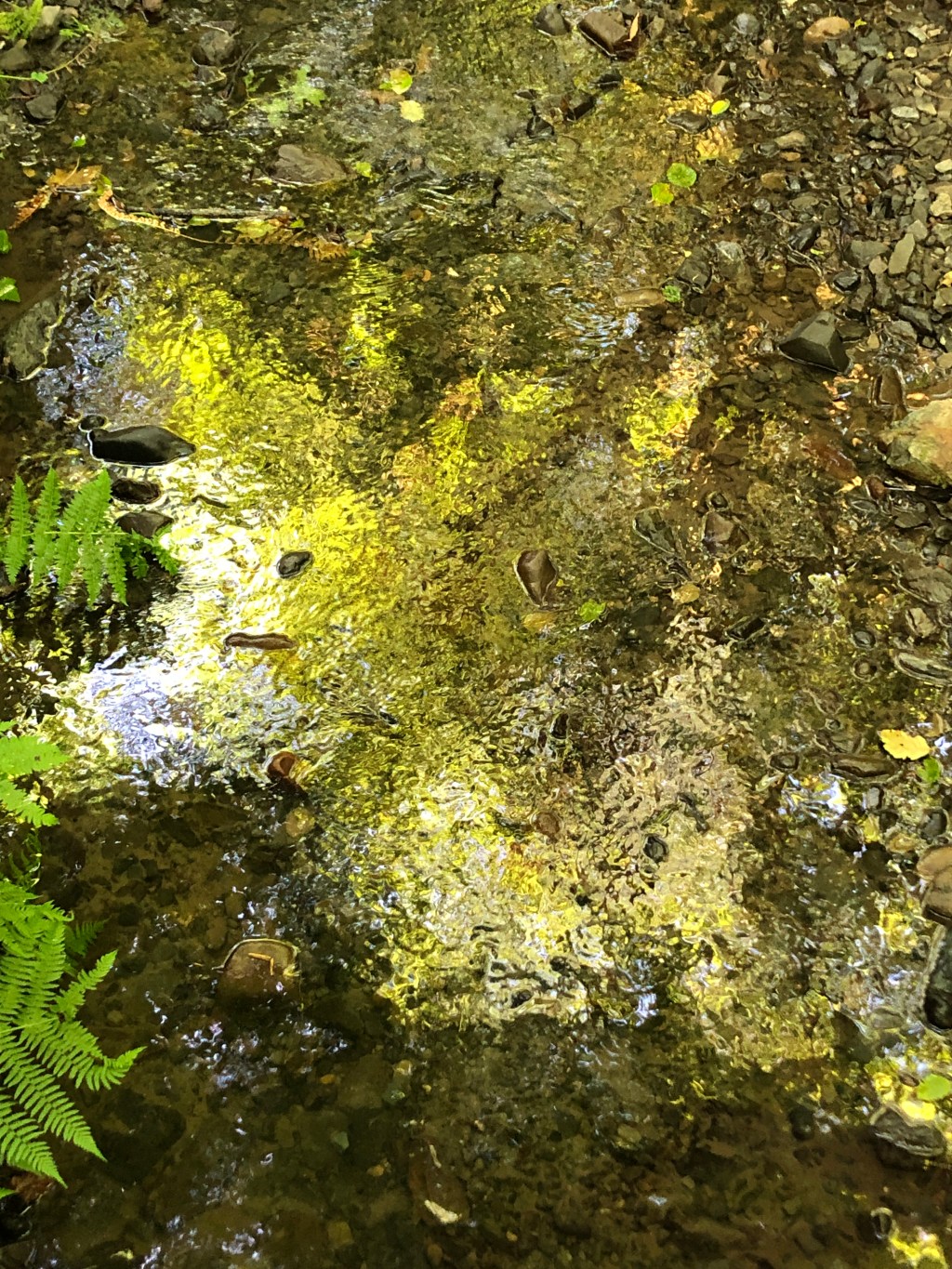
and of the too-low notes in the stream’s flow over stone
and deep beneath of the mélange shift in the continental drift
and high above it of the jumping spider stalking shadows,
and of the probing tongue of the swallowtail in buckeye blossoms,
and of the raven’s wing-whoosh and quiet chuck to itself,
and of the hawk’s deadly silence and whistling complaint,
and of the madrone’s slow dance of reaching root and twirling branch,
and of the mosses’ startling green falling into brown sleep,
and of leaves under leaves under leaves becoming soil
and of the crunch as they receive the sole of my boot,
and of the woodpecker’s trill as she rattle tap tap taps,
and of the vole shoving pine needles to nose warm sun dapple,
and of the pitched fierce buzz of a hummingbird battle,
and of the bee hoisting the iris lid to slip under to the deep nectar,
and of ancient jade polished by the sand of the river’s meander,
and of the redbuds burgeoning at once under the starling murmur,
and of the jostling from the gopher’s tunneling in determined hunger,
and of the nimbus webs of unknown weavers silvered with dew
disappearing in the sun to the sound of blue becoming bluer,
and of spring under me and over me where it finds me listening
where I arrive and silently sing to you silently listening to yourself
Footnote
“Geophony” is a newish word in ecology, used to distinguish non-biological sounds from those made by animals (biophony) and humans (anthrophony).
Christopher Smart made a lot of human sounds, including a wandering and beautiful poem called “Jubilate Agno.” He wrote it while confined to an asylum for the insane (Bedlam) with only his cat as company. 74 lines of the poem are about his cat, Jeoffry, and for these lines he is as they say known. But not known in time. He died in debtor’s prison in 1771. The poem itself wasn’t published until 1939 when someone found it while nosing through a library. So known then–if known at all–by chance.
 The Last Line